
It was in a pub in Middleton, Greater Manchester, when Mark Fraser, from Middleton Co-operating, shared what they were trying to do.
Their area had the usual problems found in poor neighbourhoods. Inside their organisation they worked in “circles” to address the problems. The circles emerged organically, depending on resources and opportunity/serendipity and local initiative.
At the time, they had circles focusing on energy, housing and advice. They had plans for early years, social care and food. Later on, it might be broadband access, food or repairs to goods.

He described how the local economy had changed, and how community wealth building was part of what they aspired to. They deliberately worked with other co-ops. During the COVID-19 pandemic, they had organised through mutual aid and seen what was possible.
Some of them had worked for the local council, so they didn’t discard the value of policy work, advocacy and campaigns. But they knew that the government wasn’t going to support what the community needed in the way they needed it.
He explained that because people’s lives don’t happen in silos, they were addressing “everything everywhere all at once”. He was clear he didn’t want funding from Lankelly Chase if it was going to make them jump through loops, consume their time or report on metrics they didn’t choose.
He knew things had to be built with care, and they needed governance and processes. They didn’t have a lot of money but they had so many other resources - space in the pub, time, skills, relationships, trust, vision.
Mark was describing the messy, interdependent reality of community life. He and his community understand the problems and are capable of organising themselves around addressing them. This raises the question: “what value does institutional philanthropy add to their work?” Obviously they need the money, but do they need the funding organisations that come with it?
Change the organisation or the system
In our last Substack, we set out why the polycrisis calls for a radically different approach. We asked whether institutional philanthropy has a role to play in the scale of transformation we urgently need.
This question points to at least two choices for an organisation such as ours. We could choose to change the organisation to make it more fit for purpose. Or we could widen our perspective beyond the organisation to look at how the whole system of resourcing needs to shift.
Changing the organisation would involve adapting strategies, structures, leadership and ways of working. This would seek to preserve the core identity and function of the organisation, while altering its internal hierarchies, goals, or resource flows. It would assume that the basic framework remains relevant to the new context and is capable of the adaptation needed.
Those of us who work in institutional philanthropy have inherited machinery that was built on legal, financial, and cultural foundations that predate modern social justice, let alone the polycrisis. This explains why we tie ourselves in knots trying to make a legacy system work for a world that couldn’t have been envisaged at its outset.
The framework accepts the endowment model. This model assumes that wealth should be preserved indefinitely, held in reserve, managed for growth and granted through distant professionals who have the necessary information and skills to make decisions in the interests of communities.
As the Three Horizons model makes clear, there are innovations that serve to extend the lifespan of legacy regimes a little longer, allowing us to believe that they are still capable of the change needed. We concluded that changing the organisation in times of crisis would serve mainly to protect the endowment model and our power by making it even harder to challenge.
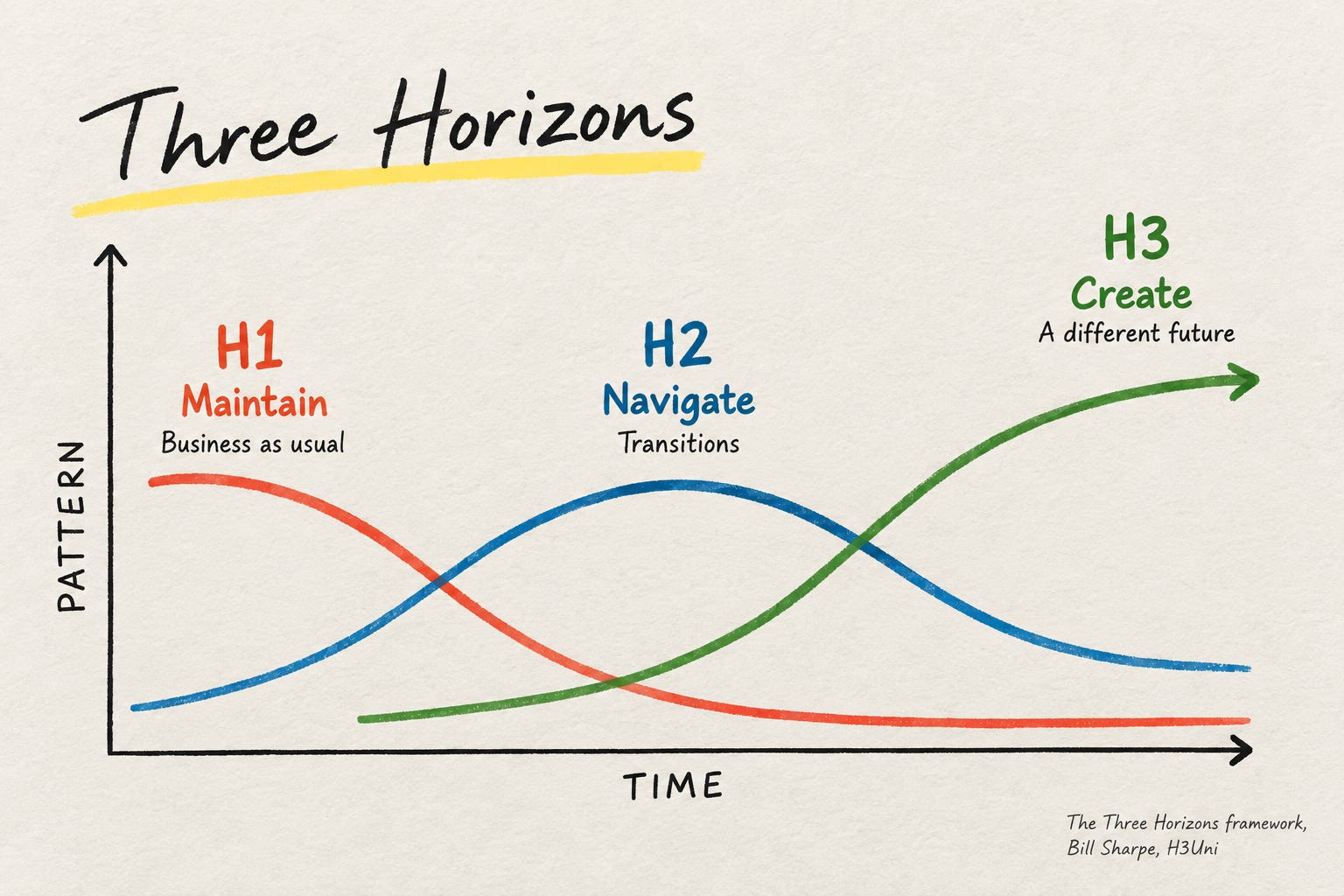
Credit: The Three Horizons framework, developed by Bill Sharpe and Anthony Hodgson. Learn more about Three Horizons
Widening our perspective to look at the resourcing system frees us from the presumption that the perpetuity of the organisation is a given. It allows us to look with fresh eyes at the reality of communities like Middleton and ask: what kind of resourcing system would genuinely be of service? What would its values and dynamics look and feel like?
These are quite different questions to: how can we improve the way we make grants? They allow us to see the opportunity costs of preserving our organisation. If we aren’t centred as holders of power, as arbiters of who needs or deserves resourcing, we can start to imagine the kinds of empowerment, self-governance and initiative that might open up in communities.
Even the best of philanthropy keeps the world of money separate from communities, denying them the chance to grapple with its complexities. Communities have little choice but to accept money that is already entangled in the harms they are trying to address. They don’t get to build critical capacity and capability in relation to how money connects with the issues they are facing.
The result is that the work is less effective than it should be because it is missing key dimensions of the complexity with which it needs to engage.
The decision to dismantle
After years of trying to improve our practice, and finding ourselves in feedback loops that maintained our institutional culture and positionality, we started to ask: “what are we willing to let go so that something else can become possible?”

In the sliding tiles game, one of the tiles has to be missing for the others to move. Our decision to dismantle the organisation came from the realisation that if philanthropic institutions talked endlessly about shifting power, but none was prepared to let go of it, then there’d be no space to discover what else might be possible. If the system is going to move, then something has to give.
It was very hard to make this decision. There was a lot of good we could do with the power we held, and a lot of people who wanted us to direct some of that good in their direction. Without institutional power, you can’t make things happen in the way that you used to. But other things become possible, other forms of power emerge, other relationships and resources become visible. The lens widens and a bigger kind of possibility beckons, even if it’s a much less certain one.

The reason we chose to dismantle and not simply stop is because we wanted to undo institutional norms and so create space for the emergence of new ones.
Stopping or sunsetting is the most common exit for a foundation. We could have opted to spend down our endowment through accelerated grant making. We could have carved up our endowment between our existing grantee base. We could have moved all of our money into our existing initiatives.
None of these would have created room for exploration of what healthier resourcing systems might look like. They would have been one last exercise of institutional power. The basic model would have been left undisturbed.
Instead we set our intention as follows:
to create space to reimagine, test and demonstrate how wealth, capital and social justice can co-exist in service to all of life now and for future generations.
This intention is a recognition that we are having to act without full information. We don’t know for sure what a transformed system might look like. We can’t define success in terms that meet the rigours of standard business plans. We don’t know all the inputs and outputs necessary to get us the outcomes we want.
This is a risky place to be, especially in a system that doesn’t reward such risk-taking. However, we took the decision knowing that the risk is manageable. At the very least, we know that we can move our assets into the ownership of community organisations on a scale that will create real public benefit. However, our intention is to create greater value than that.
Moving money is important. But we also need to gain insight into how to move the money system itself. From money fortresses to resource ecosystems. We want to know how the money could be held or stewarded in ways that serve communities. We want to understand how money can become just one asset that communities hold, and by no means the most important one.

De-institutionalising charitable money doesn’t just mean giving it away. It means decoupling it from the values and dynamics of a system that has run out of road.
Dismantling has become necessary if we are to build something different. Retrofitting works for some contexts, but not when our institutional norms are so entangled in harmful dynamics and feedback loops. We want to move money and reimagine the terms on which money can be held and stewarded differently.
This is a risk worth taking.
I’ve been reading this while also re-reading James Baldwin’s The Fire Next Time and the two have I think overlaps. There is a lot in this piece that resonates, particularly the argument that real transformation requires institutions to question not just what they do, but the assumptions and power structures that allow them to exist in the first place. But Baldwin has made me read it with some discomfort too. One of the things that runs through the novel is his challenge to innocence, the gap between the stories we tell ourselves about who we are and the material reality of what we do. Understanding injustice, or declaring yourself opposed to it, isn’t enough. The much harder question is what happens when that understanding requires you to give something up.
That feels like a useful lens for thinking about philanthropy. When LC announced it would stop conventional grant-making and ultimately spend down, organisations working on reform, including ones like ours, lost funding. I understood the radicalism of the proposition, if the way wealth is accumulated, held and distributed reproduces existing power, perhaps the answer isn’t simply to become a better grant-maker, but ultimately to relinquish the money and the power that comes with it. But several years on, I find myself wondering about the gap between the proposition and the practice. There is something uncomfortable about institutions with resources having the luxury of taking years to reflect on how power should be redistributed, while organisations and communities without those resources are navigating rising need, shrinking funding and increasingly fragile infrastructure.
Which brings me back to Baldwin. His critique of innocence pushes us beyond what we believe about ourselves and towards some much simpler, more material questions such as who has the money, who controls it and who decides when it moves. And of course who carries the consequences while those decisions are being made. None of this means the critique of traditional philanthropy is wrong. I think much of it is right. And it certainly isn’t an argument for preserving philanthropy as it is. But transformation surely has to be material as well as philosophical. Perhaps that’s the question I am left with so if we have concluded that holding power is part of the problem, how long can we spend imagining its relinquishment before we actually have to give something up?
I love this intention ...
"to create space to reimagine, test and demonstrate how wealth, capital and social justice can co-exist in service to all of life now and for future generations."
... and feel that this is something that is needed more widely to enable the shifting of mindsets, and for decision makers to step out of autopilot and be more questioning of whether decisions are leading to the intended outcomes.
I'd love to hear the ways that Lankelly is creating this space!